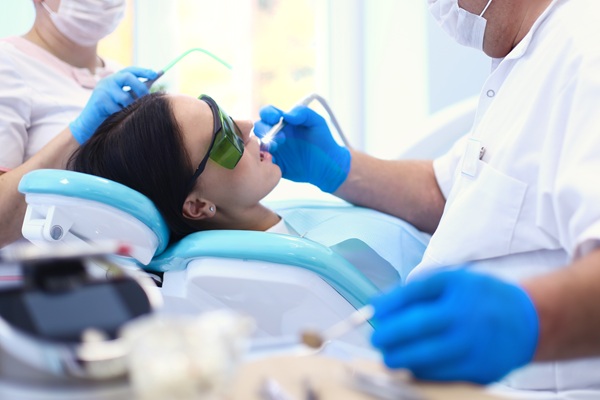
Laser dentistry has transformed how prosthodontists handle many traditional surgical and technical procedures; many advanced devices have been developed to increase the quality of care provided to patients. Dental lasers are developed to treat issues affecting the hard and soft tissues and the teeth.
Applications of lasers in prosthodontics
The prosthodontist can use lasers' focused energy to remove excess gum tissue safely. It also reduces bleeding and swelling, as well as killing germs, reducing the risk of infection. Laser dentistry can also minimize the need for dental anesthetics, allowing the prosthodontist to better control bleeding, reduce swelling after a procedure, and minimize discomfort. The following are ways a prosthodontist might apply laser dentistry.
Crown lengthening
There are circumstances in which crown lengthening procedures are necessary; this requires attention to achieve aesthetically-pleasing outcomes. Laser dentistry can be helpful in precisely tracing incision lines and sculpting the ideal gingival border shape because lasers provide unrivaled accuracy and control. All other crown lengthening methods have disadvantages in terms of surgical approach, healing time, post-healing gingival margin position, and patient compliance, as electro-surgery requires the use of anesthesia and a scalpel.
Soft tissue modification surrounding laminates
An argon laser can remove and re-contour gingival tissues. The laser can be employed as the main instrument to remove both diseased and non-diseased gingival tissue following medication therapy or orthodontic treatment. The laser will remove tissue, provide hemostasis, and allow tissues to reattach to the wound.
Teeth bleaching
In today's culture, visual appeal and a good smile are essential. Teeth bleaching can be done at the dental office. Diode lasers are used to bleach teeth without creating dental discomfort or altering the tooth's appearance.
Veneer removal
Using laser beams, restorations may be removed by the prosthodontist without cutting. The laser energy is absorbed by the water molecules in the adhesive and passed through the porcelain glass unaltered. Without inflicting any damage to the underlying tooth, debonding occurs at the intersection of the silane and the resin.
Dental implants
A prosthodontist can apply laser dentistry for implant recovery, implant site preparation, and detachment of diseased tissue around the implant. Following the insertion of the implant and its integration into the osseous substrate, the treatment technique is to surgically expose the implant, wait for the tissue to heal, and then begin impressions and restoration manufacturing.
This procedure can be accelerated with the use of lasers since it is possible to expose the implant and take the imprints at the same time. Dental implants can be removed using a variety of lasers. Lasers can also be used to insert tiny implants in patients who are at risk of bleeding, allowing for bloodless surgery in the bone.
Removable prosthetics
Preoperative examination of the supporting hard and soft tissue structures and their correct preparation is required to fabricate removable complete and partial dentures. Most pre-prosthetic procedures may now be performed using lasers.
Lasers can be effective
Laser dentistry improves dental procedures; the dentist's ability to regulate the power output and length of exposure on both hard and soft tissues allows for the treatment of a particular region without causing damage to adjacent tissues. If you want to learn more about laser applications, book an appointment today.
Request an appointment here: https://www.periocafe.com or call Brighton Periodontal & Implant Dental Group at (818) 703-7733 for an appointment in our Woodland Hills office.
Check out what others are saying about our dental services on Yelp: Laser Dentistry in Woodland Hills, CA.
Recent Posts
Regenerative periodontal care focuses on rebuilding the tissues that support the teeth, in which a regenerative dentist may use procedures that encourage the body's natural healing response. In periodontal practice, this often means restoring bone, periodontal ligament, or gum tissue that has been damaged by disease or recession. The term does not describe a separate…
Sedation dentistry helps patients stay calm, allowing periodontists to efficiently perform their work while ensuring their patient's comfort and safety. Many people suffer from severe dental anxiety. This fear can stop them from receiving the treatment they need and make their oral health suffer long-term, requiring more extensive treatment. Fortunately, there have been advancements in…
A prosthodontist can be a vital resource if you have missing teeth and want to restore your smile. Living without teeth can be both embarrassing and challenging to your health. It is nice to know that there are solutions to this condition. A general dentist can help treat tooth loss, but prosthodontists can offer care…
All-on-4® dental implants are a stable, natural-feeling way to replace an entire smile. It is a popular choice for those seeking reliable smile restoration, including those who have already tried removable dentures. Many denture wearers experience slippage, sore spots, and difficulty chewing, which makes meals and social interactions challenging. With All-on-4, periodontists eliminate these issues…